“Great speakers don’t just speak. They echo.”
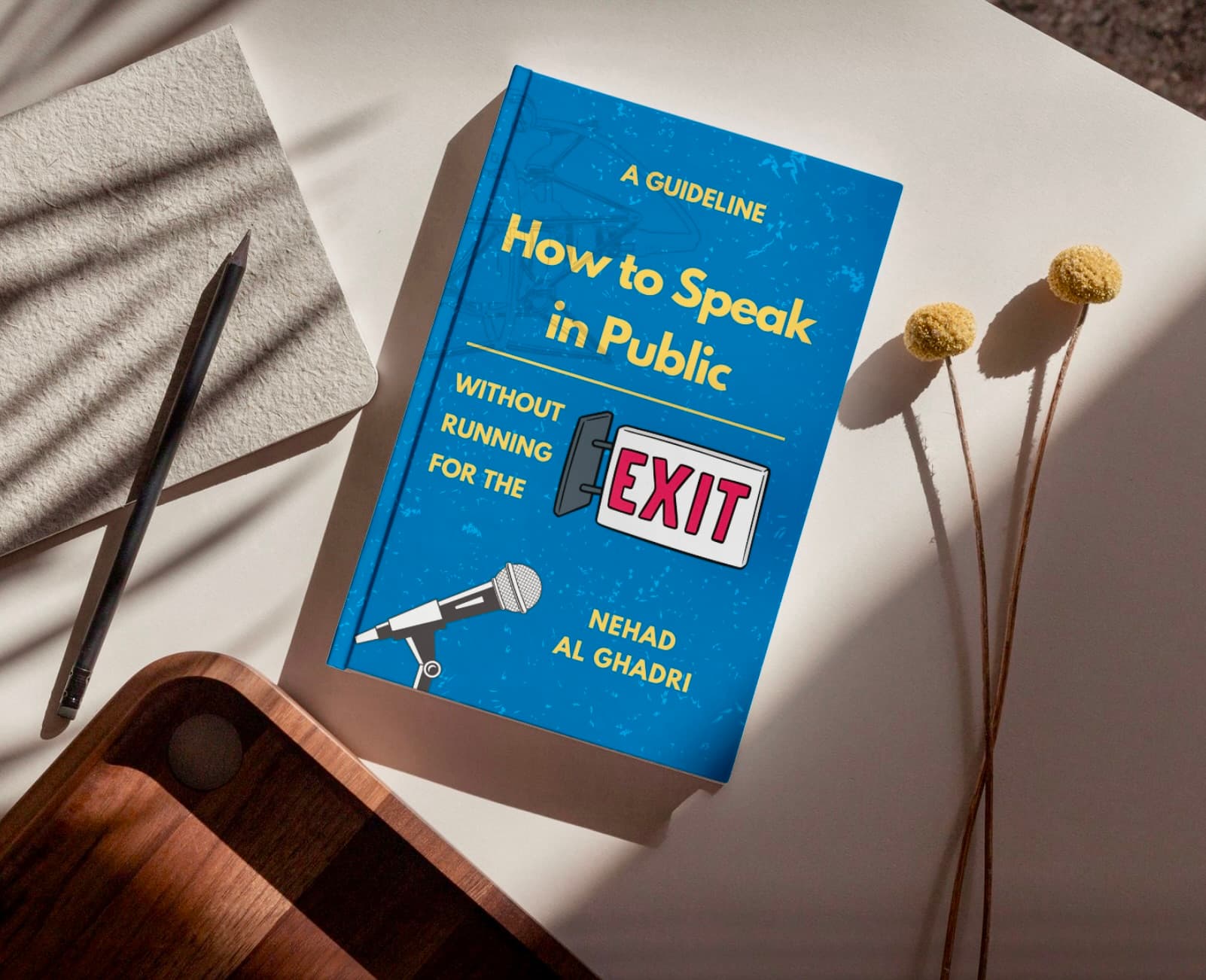
How to Speak in Public Without Running for the Exit.
Public speaking doesn’t have to be scary. In fact, it can be your greatest strength.
117 pages written from the perspective of an introvert who became a corporate trainer by accident. It argues that public speaking is identity work disguised as skill work, and that the technique only takes once you’ve made peace with your own voice. Written for anyone who feels their stomach drop when the projector clicks on.
A learnable skill, not a personality trait
Most public speaking advice is technique, breath, posture, the rule of three, eye contact at the back of the room. All of it is true. None of it works on the people who need it most: the ones who’ve quietly internalized that speaking in public is a thing other peopledo. Confident people. Charismatic people. People whose stomachs don’t drop when the projector clicks on.
I wrote this book because I was one of those people. I spent my childhood hiding behind books and my school years insisting I would never, ever work as a teacher. Then my first corporate job put me in front of a training room, and I had to figure out the hard way that being a good public speaker has almost nothing to do with being an extrovert, and almost everything to do with what you believe about your own voice.
The book walks through the identity work first, normalizing the fear, locating your real voice, making peace with being wrong in public, and only then the technique layer (structure, delivery, engagement, Q&A handling). The order is the lesson. Most public speaking training fails because it gets the order backwards.
Written in the same voice I use on LinkedIn: self-deprecating, reversal-first, personal story before technique. Equally usable for someone preparing a single nervous best-man speech and for a manager building out their team’s presentation capability.
Eight chapters, one arc
An introduction to the book's core promise: public speaking is a learnable skill, not a personality trait, and this is the field guide that proves it.
Why the fear you feel before stepping on stage is universal, including in speakers who look completely composed, and the first move toward stopping it from running the room.
The identity work half of public speaking: locating your real voice, making peace with being wrong in public, and learning to use the fear instead of fighting it.
How to architect a talk that actually lands: opening hooks, the three-beat narrative structure, transitions that don't break the audience's trust, and the closer that earns the applause.
Breath, posture, pacing, voice, and the small delivery choices that quietly separate a speaker being watched from a speaker being followed.
The moves that turn passive listeners into active participants: deliberate eye contact, the art of the pause, asking questions you actually want answered, and reading the room in real time.
How to handle the moment most speakers fear most: hostile questions, surprise questions, questions that try to derail you, and the difference between answering a question and disarming it.
Integrating the skill into who you are at work, at home, and in the rooms that matter, and why the speakers who compound over decades treat public speaking as identity work, not a performance trick.
Ready to stop running for the exit?
Available now on Amazon as both eBook and paperback. If you read it and it helps, tell someone else who needs to hear it. That’s the only marketing this book has.
Available on Amazon